
Starting with calendar year 2026 emissions, Colorado facilities that file annual emission reports under Regulation 3 will submit them through EPA's Combined Air Emissions Reporting System (CAERS), with reports due June 30, 2027. The system opens in mid-January, but the Air Pollution Control Division (APCD) is asking facilities to pre-register by December 1, 2026 and set up EPA access by December 15 so they are ready before reporting starts.
This post covers who is affected, the key dates, and the seven preparation steps APCD presented at its November 5, 2026 CAERS training.
What CAERS is and why Colorado is using it
CAERS is an EPA-built web application that lets facilities report air emissions to participating state, local, and tribal agencies. It is hosted by EPA, administered in Colorado by APCD, and accessed through EPA's Central Data Exchange (CDX), the same login portal used for reporting such as CEDRI.
The move supports Colorado's expanded air toxics program. House Bill 22-1244 directed the state to build an air toxics program, and in 2025 the Air Quality Control Commission revised Regulation 3 to require more detailed annual reporting of toxic air contaminants (TACs) and criteria pollutants. CAERS is the system that will collect that data.
Two changes will affect most facilities:
More detail. Emissions and operating data are reported at the equipment, activity, or process level, not just as a facility total.
One certifier. Each facility designates a single person who legally certifies and submits the report.
Who has to report
CAERS reporting applies to downstream oil and gas facilities and non-oil and gas facilities that meet at least one of these criteria:
Title V major source
Synthetic minor source
Certain metal processes (such as electroplating, welding, or thermal spraying) in specified NAICS codes that exceed cadmium, nickel, or hexavalent chromium thresholds
Ethylene oxide emissions of 0.032 lbs/year or more
Toxics Release Inventory (TRI) reporting of TACs listed in Regulation 3, Appendix C
Upstream and midstream oil and gas operations continue to report through ONGAEIR, not CAERS.
APCD has published an expected reporters list. If your facility meets the criteria but is not on the list, you are still responsible for reporting and should request that APCD add it (Step 2 below).
Key dates
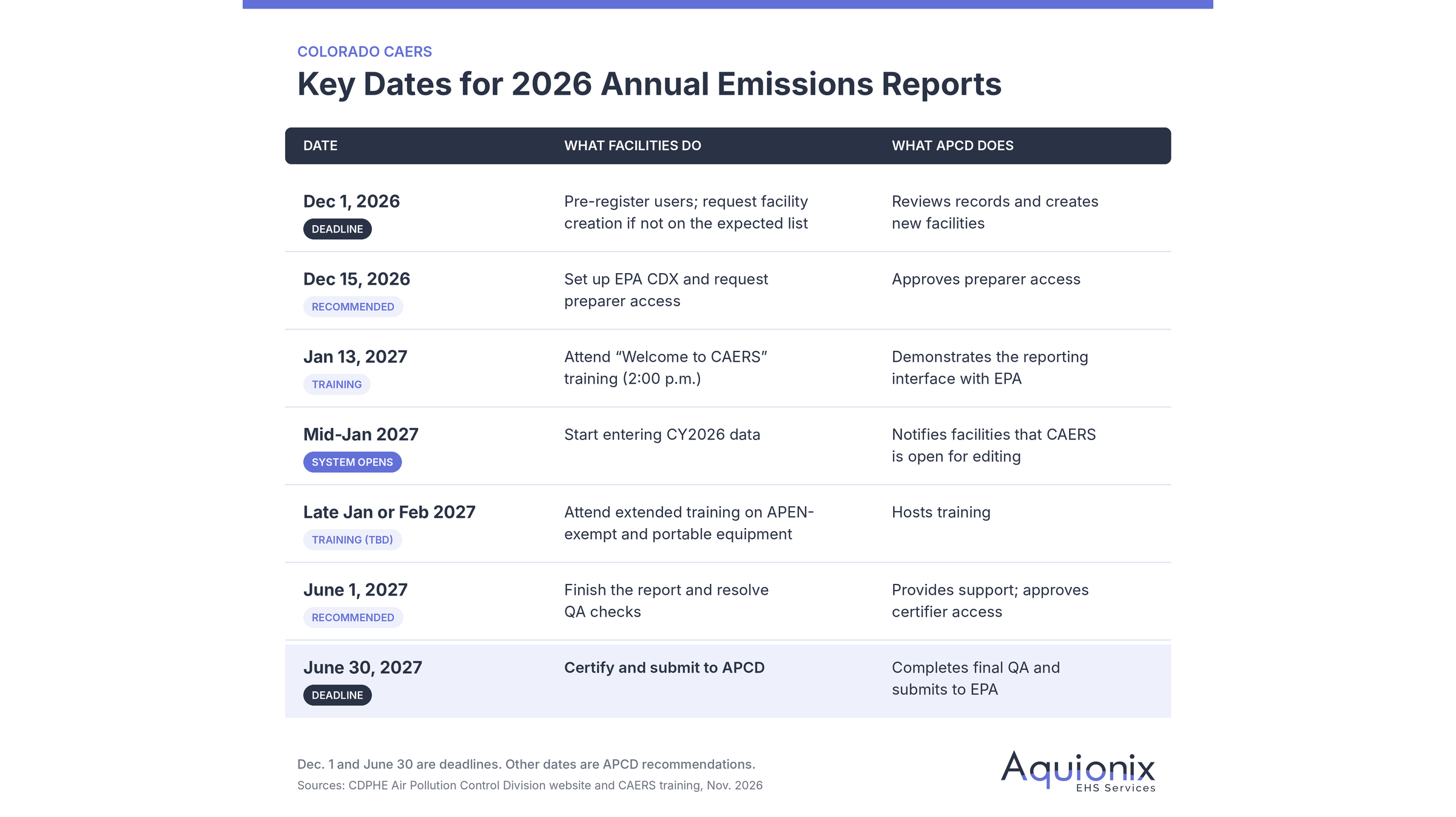
Reports are due June 30, 2027, and CDPHE requires the pre-registration form by December 1, 2026. The other dates below are APCD recommendations, but we suggest meeting them anyway, as access approvals can take time.
December 1, 2026 (deadline): Pre-register users and request facility creation if you are not on the expected reporters list.
December 15, 2026 (recommended): Set up EPA CDX and request preparer access.
January 13, 2027: “Welcome to CAERS” training, 2:00 p.m.
Mid-January 2027: CAERS opens. Start entering CY2026 data.
Late January or February 2027 (TBD): Extended training on APEN-exempt and portable equipment.
June 1, 2027 (recommended): Finish the report and resolve QA checks. APCD approves certifier access.
June 30, 2027 (deadline): Certify and submit to APCD.
What to do before reporting opens
Steps 1 through 5 set up access. They take little time individually, but approvals run through both APCD and EPA, so start now.
Step 1: Decide who will use CAERS. CAERS has two roles:
Preparer: builds and edits the report. A facility can have several, including consultants.
Certifier: reviews, edits, and legally certifies the report to APCD. Only one per facility.
One account can be linked to multiple facilities, which helps companies with several sites.
Step 2: Confirm your facility is on APCD's expected reporters list. If it meets the applicability criteria but is missing, submit a Facility Creation Request Form, one per facility, by December 1.
Step 3: Pre-register users with APCD. Submit the Colorado CAERS User Registration Form by December 1. Multiple users per facility can be listed on one form.
Step 4: Set up your EPA CDX account. New users register in CDX. Existing users, such as those who report to CEDRI, add the CAERS program service. The role you request affects timing:
Preparer only: register now.
Certifier who will also prepare: register as a preparer now; APCD will announce when to request the certifier role.
Certifier only: wait, since EPA may require additional verification for certifiers.
Step 5: Request access to your facility in CAERS. In CAERS, select the Colorado Department of Public Health and Environment as the agency, search by facility name or Agency Facility ID, and select "Request Access." Approval comes by email from cdphe_apcd_caers@state.co.us.
The Agency Facility ID is a new identifier derived from your AIRS ID. APCD has said its Colorado user manual will explain the conversion. Searching by facility name is the safer option until then.
Preparing your data for January
Step 6: Review the preloaded equipment data. Once you have facility access, you can view preloaded data in CAERS or download it as a template (.csv, .xls, or JSON). You cannot edit it until reporting opens in January.
The data currently preloaded is from 2024. EPA plans to load 2025 data in mid-January.
Because APENs renew on a five-year cycle, preloaded equipment lists may not reflect recent changes.
Facilities new to reporting may see no preloaded data at all.
Use the preloaded data as a starting point. Check it against your current permits, APENs, and what is actually operating on site.
Step 7: Start collecting 2026 operating data. Starting in January, you will need to update or confirm:
Equipment operating status
Control devices
Stack or fugitive release parameters
RY2026 operating parameters
Emissions
Check APEN-exempt equipment carefully. An APEN exemption does not automatically exempt equipment from Regulation 3 annual emissions reporting. APCD has published a list of reporting exemptions on its CAERS website and plans to cover APEN-exempt and portable equipment in more detail at its late January or early February training.
What's still being decided
Several details are still pending from APCD. We will update this paper as guidance is released.
Reporting fees. APCD will not charge CAERS reporting fees for calendar year 2026 reports. Future fees depend on an Air Quality Control Commission hearing planned for February 2027.
APEN-exempt and portable equipment. Detailed reporting instructions are expected at the extended training.
AIRS ID conversion. The Colorado CAERS user manual is expected to explain how AIRS IDs map to Agency Facility IDs.
Certifier approvals. EPA's additional verification process for certifiers has not been fully described.
How Aquionix can help
Aquionix helps facilities along the Front Range with air permitting, APENs, and annual emissions reporting. We can register as a CAERS preparer for your facility, review your preloaded equipment data against current permits and APENs, identify APEN-exempt equipment that may need to be reported, and build your 2026 emissions inventory.
If you have questions about whether CAERS applies to your facility or would like help getting set up, contact us at info@aquionix.com.
Resources
Colorado CAERS page (CDPHE): registration forms, expected reporters list, training recordings, and updates
Annual emissions reporting applicability and exemptions (CDPHE)
EPA CAERS page: user guide and training materials
APCD CAERS support: cdphe_apcd_caers@state.co.us
Source: APCD "Introduction to CAERS" training, November 5, 2026, and the CDPHE and EPA pages above.