
New Permitting Requirements Associated with the Re-designation of the Denver Metro / North Front Range Ozone Nonattainment Area from Serious to Severe Nonattainment for the 2015 Ozone NAAQS
The Denver Metro / North Front Range Area (DMNFRA) was originally designated as “Marginal Nonattainment” for the 2008 ozone National Ambient Air Quality Standard (NAAQS) of 75 ppb in July 2012. The situation has not improved since that date and ozone concentrations have remained stubbornly high over the years causing the US Environmental Protection Agency (EPA) to repeatedly downgrade the designation, first to “Moderate Nonattainment”, then to “Serious Nonattainment”, until reaching the current status of “Severe Nonattainment”.
With each downgrade, a series of more stringent permitting, reporting, and compliance requirements have been imposed on new and existing emissions sources in the area. Figure 1 below shows the DMNFRA currently classified as “Severe Nonattainment” for the 2008 ozone NAAQS.
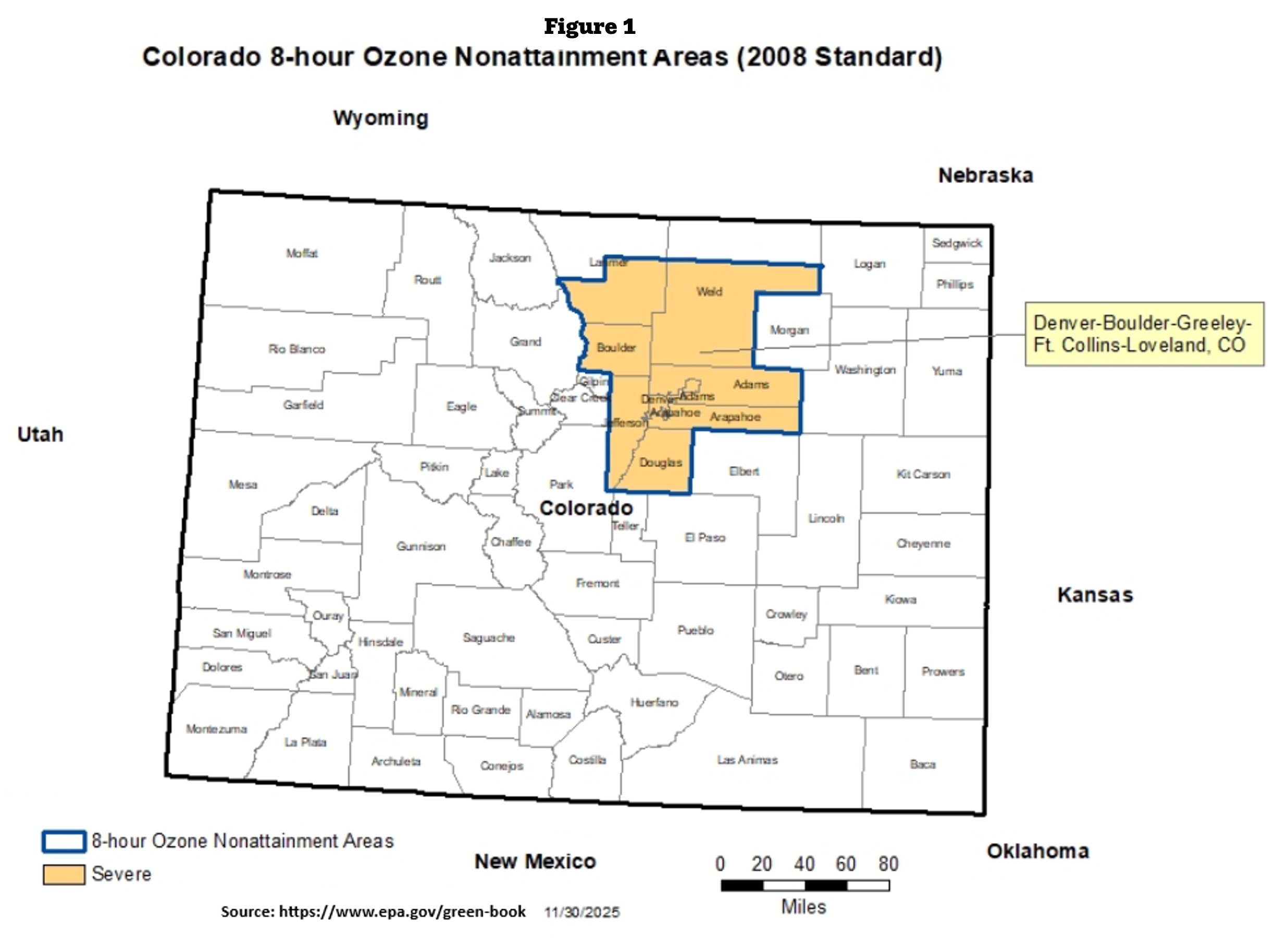
Note that DMNFRA does not include the northern portion of Weld County, which currently remains in attainment with the 2008 ozone NAAQS.
In 2015 the EPA promulgated a new, more stringent ozone NAAQS of 70 ppb while at the same time leaving in effect the existing 2008 NAAQS. This placed the DMNFRA in a unique situation of being in different attainment statuses for two separate ozone standards at the same time.
As a result, after 2015 the DMNFRA has additionally been re-designated three times as “Marginal”, “Moderate” and “Serious” nonattainment for the newer 2015 ozone NAAQS, and was also expanded by a court decision to include the entirety of Weld County, but this expansion applied only to the 2015 NAAQS thus in practice creating a second, expanded DMNFRA shown in Figure 2 below.
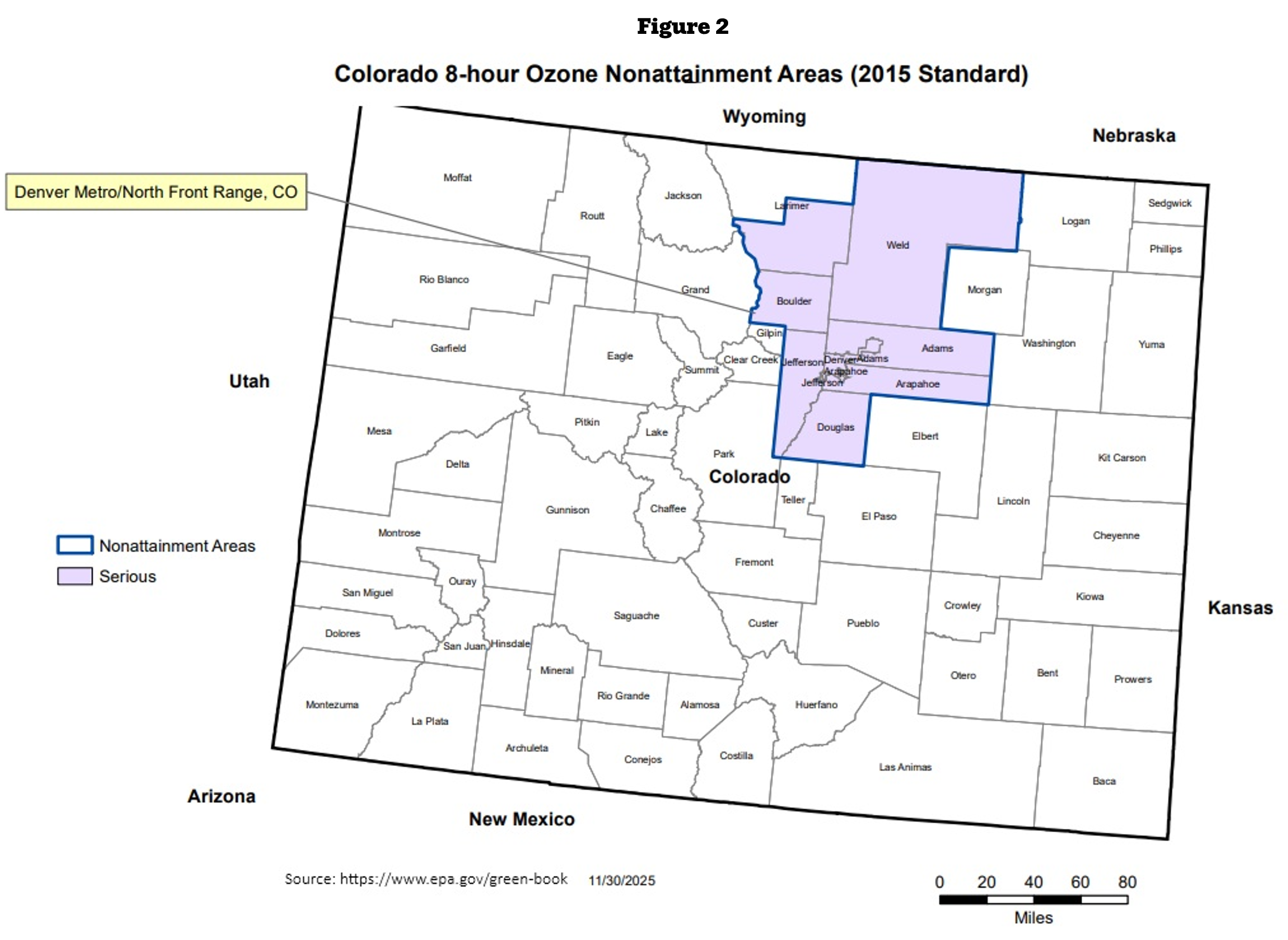
In summary, the DMNFRA is currently in “Severe Nonattainment” status for the 2008 ozone NAAQS, and the expanded DMNFRA is in “Serious Nonattainment” status for the 2015 ozone NAAQS.
On November 21, 2025, the Colorado Department of Public Health & Environment (CDPHE) announced a plan to proactively downgrade the expanded DMNFRA to “Severe Nonattainment” status in anticipation that the 2015 ozone standard would not be met by the established deadline of August 2027. This means that in the next several months, once the new designation is approved by the EPA and published in the Federal Register, new and existing emission sources in the northern portion of Weld County will be subject to the more stringent permitting, reporting, and compliance requirements associated with the “Severe Nonattainment” status. While CDPHE hasn’t issued any specific guidance yet, based on existing regulations and previous actions and rulemaking, the following changes can be expected.
New Sources
Of the criteria pollutants defined under the Clean Air Act, Nitrogen Oxides (NOx) and Volatile Organic Compounds (VOC) are two ozone precursors whose emissions are limited by the Federal and Colorado air permitting programs. Thus, with the change to “Severe Nonattainment” status, the Major Stationary Source Threshold for NOx and VOC will go down from the current 50 tons per year (tpy) to 25 tpy. This means that any new emission source applying for a permit in this area with a Potential to Emit (PTE) above 25 tpy of NOx and/or VOC will be considered a major stationary source and therefore will be subject to the Prevention of Significant Deterioration (PSD) and/or Nonattainment New Source Review (NSR) Permitting Programs governed by Colorado Regulation 3 Part D.
The main requirements of Nonattainment NSR permits in “Severe Nonattainment” areas are the use of Lowest Achievable Emission Rate (LAER), the requirement to pay fees for precursor emissions, a mandatory public comment period prior to permit issuance, and the obligation to offset any permitted increase in emissions of ozone precursors with a decrease of those same pollutants anywhere else inside the nonattainment area. This decrease in emissions must be by a ratio of 1.3 tons per each ton of permitted emissions increase.
The new source would require a Nonattainment NSR permit on account of the ozone precursor emissions (NOx and/or VOC) above the 25 tpy threshold, but because of the Major Stationary Source status, it might also require a PSD permit for the other criteria pollutants (PM2.5, PM10, CO and SO2) if the corresponding pollutant Significant Emission Rates (SERs) are exceeded. PSD permits involve:
- The use of Best Available Control Technology (BACT)
- Air quality modeling to demonstrate compliance with the NAAQS and PSD Increments
- Air quality modeling to evaluate impacts on protected Class I areas (e.g. national parks, wilderness areas, etc.)
- A mandatory public comment period prior to permit issuance
Finally, the new source will also have to apply for a Title V operating permit, which would make the facility subject to additional reporting, recordkeeping and monitoring requirements. It would also be subject to more frequent inspections by the state and/or federal regulatory agencies, and to a mandatory public comment period during the permitting process.
Existing Sources
Any existing facility that is currently classified as a minor source under the “Serious Nonattainment” status would automatically become a Major Stationary Source after the re-designation to “Severe Nonattainment” if its permitted NOx and/or VOC emissions exceed the new 25 tpy threshold. This change by itself will not trigger any permitting requirements under the PSD and Nonattainment NSR Programs so long as the facility is not making any modifications or does not have any pending construction permits waiting to be issued at the time of the re-designation. However, now as a major source the facility will be required to apply for a Title V Operating Permit, likely within a year of the change of status.
Another important aspect for existing minor sources that become a major source as a result of the re-designation to “Severe Nonattainment”, is that any future modification that requires a permit will be evaluated against the SERs to determine if the modification is treated as a minor or a major modification.
The SER for NOx and VOC in “Severe Nonattainment” areas is 25 tpy. For the other criteria pollutants, the SERs remain the same: 15 tpy for PM10, 10 tpy for direct PM2.5, 40 tpy for SO2, and 100 tpy for CO.
Any modification to an existing major source in the “Severe Nonattainment” area that exceeds these thresholds will be considered a major modification and therefore will be subject to the PSD and/or Nonattainment NSR Permitting Programs and to the corresponding requirements associated to these programs as listed before.
If you think the new requirements apply to you or have questions, please feel free to reach out to us.